
Some links are affiliate links. Each review says whether I used the tool myself. Full disclosure
In this article (11)
- Who This Review Is For
- TL;DR Box
- What Is Robinhood?
- Who Is It For?
- What Robinhood Features Did I Test?
- How Much Does Robinhood Cost?
- How Does Robinhood Compare to Webull, Moomoo, and Fidelity?
- What Are Robinhood’s Drawbacks?
- Is Robinhood Worth It for Side Earners in 2026?
- Frequently Asked Questions
- Related Posts
Who This Review Is For
If you earn a side income on top of a day job, you spend your spare hours building an audience, launching digital products, and securing brand deals. You finally start seeing that extra income hit your bank account. But what happens next? Leaving that hard earned cash sitting in a traditional savings account earning pennies in interest is one of the biggest mistakes you can make. To truly build wealth, you need to put your money to work.
For years, the stock market felt like an exclusive club reserved for Wall Street insiders and wealthy professionals. The barriers to entry were incredibly high, with confusing interfaces, steep account minimums, and punishing commission fees on every single trade. Then Robinhood arrived and completely disrupted the financial industry. By introducing zero commission trading and a beautifully simple mobile interface, they forced every major brokerage to change their business model.
Today, Robinhood has evolved far beyond a simple stock trading app. It now offers cryptocurrency, retirement accounts, high yield savings, and even a credit card. It positions itself as the ultimate all in one financial hub for the modern digital worker. But with so many new competitors entering the space, and a history of controversial platform outages during highly volatile market events, is it still the right choice for your money? Can creators really build wealth using a free investing app?
TL;DR Box
- Best for: Creators, side hustlers, and absolute beginners looking for a simple way to start investing.
- Price: Free for basic accounts. $5 per month for Robinhood Gold.
- Features: Commission free stocks, options, crypto, fractional shares, Roth IRAs, and high yield cash sweeps.
- Customers: 27.0 million funded customers as of Q4 2025 (Robinhood Q4 2025 earnings).
- Verdict: 7.8/10. It remains the best free entry point for creators investing side income, despite lacking advanced research tools.
What Is Robinhood?
Robinhood is a pioneer in the financial technology space, offering a mobile first brokerage platform that allows users to trade stocks, exchange traded funds, options, and cryptocurrencies without paying direct commission fees. The company has 27.0 million funded customers and generated $4.5 billion in revenue for full-year 2025, up 52% year-over-year (Robinhood Q4 2025 earnings).
Founded in 2013 by Vladimir Tenev and Baiju Bhatt, the company was built on a singular mission to democratize finance for all. Before Robinhood, buying a single share of a company often cost between $5 and $10 in brokerage fees, making it mathematically impossible for small investors to build a diversified portfolio. By eliminating these fees and introducing fractional shares, Robinhood allowed anyone to invest in major tech companies with as little as one dollar.
The platform operates primarily through its highly polished mobile application, though a desktop web version is also available. Over the years, they have expanded their product suite to include retirement accounts with matching contributions, a cash management system that functions similarly to a high yield savings account, and a dedicated credit card. They monetize their free platform primarily through Payment for Order Flow, earning small rebates from market makers for routing user trades through their systems.
Who Is It For?
Robinhood is designed specifically for digital natives, beginners, and side hustlers who want a frictionless, visually appealing way to manage their investments from their smartphones. The platform skews young: roughly three-quarters of Robinhood’s customers were 43 or younger as of late 2024, with a median age around 35 (Business of Apps).
If you are a creator who just made your first $500 from a digital product launch and you want to invest it in an S&P 500 index fund without reading a 50 page manual, Robinhood is perfect for you. The interface is clean, the onboarding process takes less than ten minutes, and the educational snippets provided within the app are easy to digest. It removes the intimidation factor entirely.
Conversely, if you are an advanced day trader who relies on complex technical indicators, Level 2 market data, and deep fundamental analysis, Robinhood will feel incredibly restrictive. The charting tools are basic at best, and the platform does not support trading in mutual funds or fixed income bonds. It is a tool built for simplicity and accessibility, not for professional institutional trading.
What Robinhood Features Did I Test?
I actually use Robinhood. I keep three accounts here: a standard individual brokerage, the newer Agentic account (which I have connected to Claude for AI-assisted trades), and a small crypto sleeve. The balances are deliberately modest because this is side income I am building around a full-time kitchen job, not a hedge fund. Where exact fees or policies matter I still cite Robinhood’s own disclosures, but the walkthrough below comes from screens I look at every week.
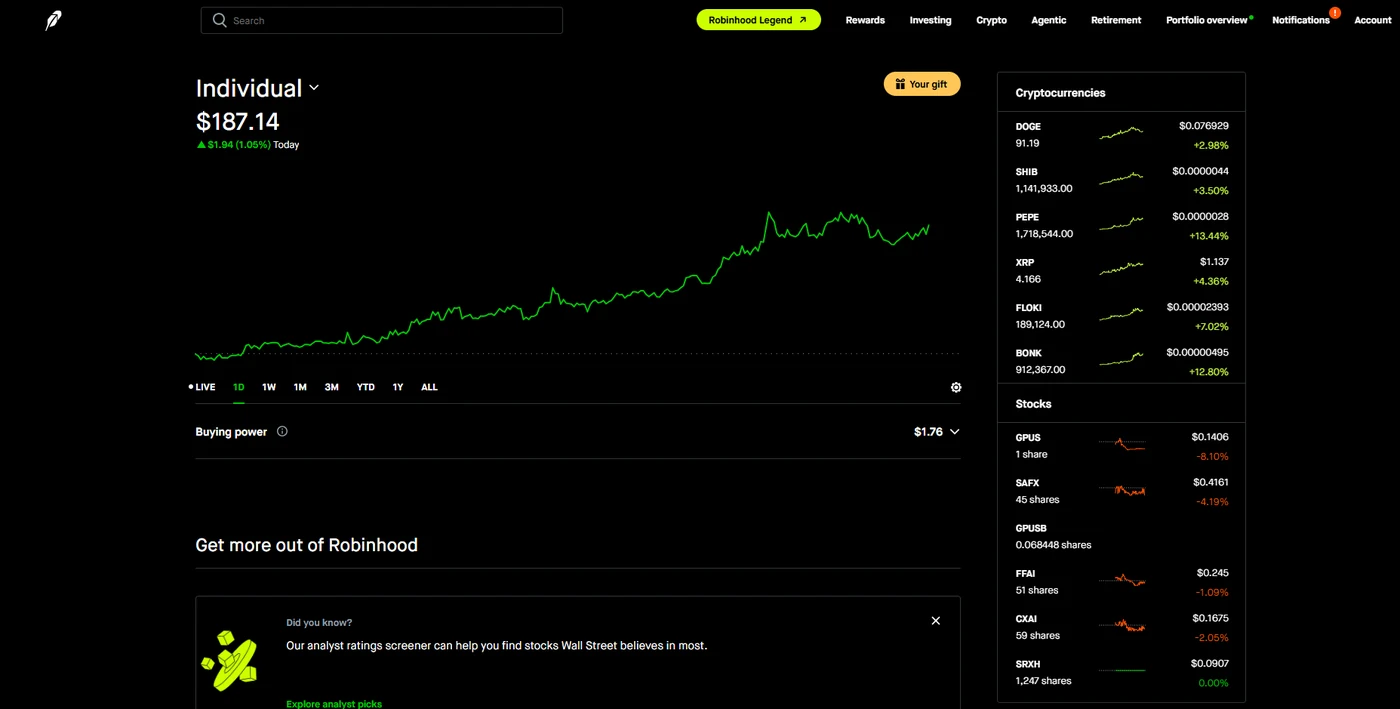
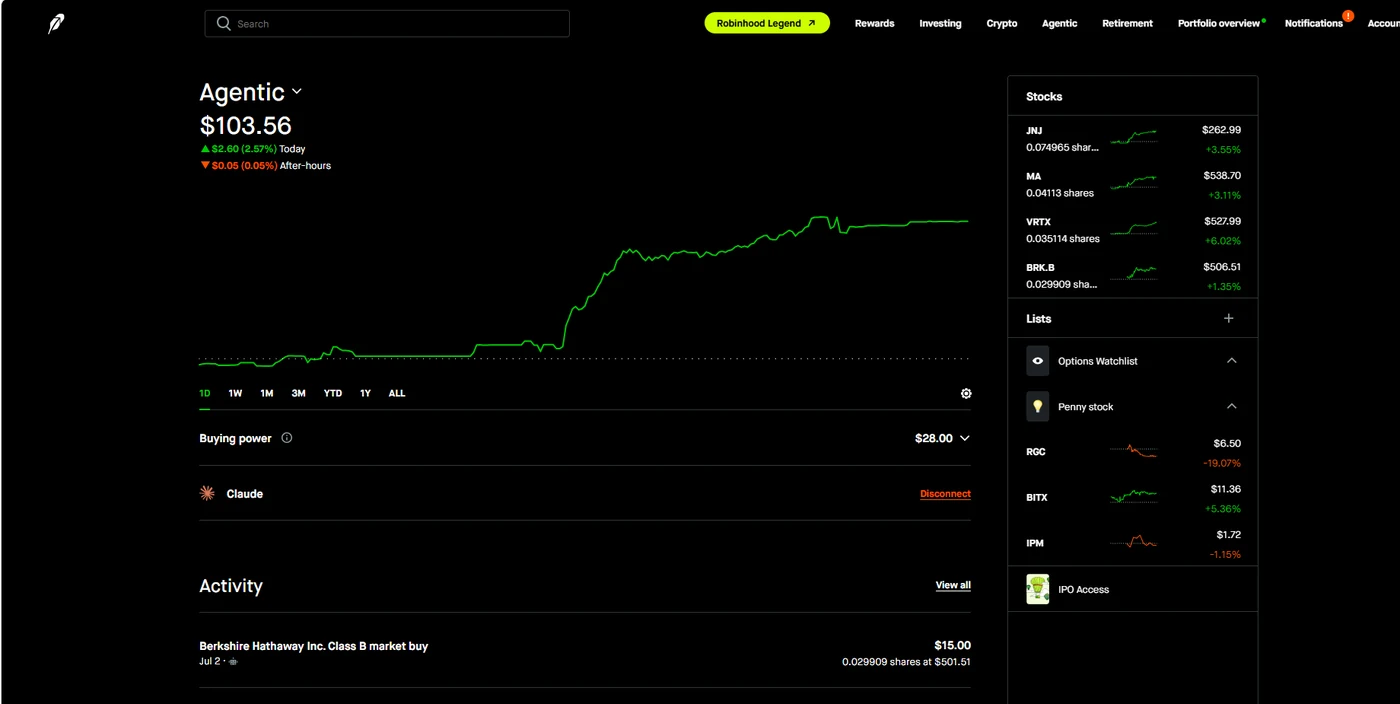
Below is how the platform handles everything from basic stock purchases to retirement planning, based on its published features and documentation.
Stock Trading
Stock trading is the core of the platform. The instant deposit feature lets eligible users access funds immediately without waiting for the bank transfer to clear. The buying process is designed to be fast: you can search for, select, and purchase fractional shares of multiple stocks in minutes. The interface clearly displays your average cost, total return, and portfolio diversity in a clean visual format.
Options Trading
Options trading requires applying for approval, which involves answering a questionnaire about your investing experience. Trading options on Robinhood is commission free, which is a major advantage over traditional brokers that often charge per-contract fees. However, the gamified design carries real risks here: the app makes buying complex derivative contracts feel almost like a video game, which can easily lead inexperienced investors to take on far more risk than they understand.
Cryptocurrency Trading
Robinhood Crypto operates as a separate entity but is seamlessly integrated into the main app. The process is identical to buying a stock, and it supports fractional crypto purchases such as Bitcoin and Ethereum. While the coin selection is smaller than dedicated exchanges like Coinbase or Binance, it covers all the major assets. Importantly, Robinhood now allows you to transfer your crypto to external wallets, a feature it lacked for many years.
Retirement Accounts/IRA
One of their best newer features is the Robinhood IRA, which supports Roth and traditional accounts. The standout benefit here is the IRA match: Robinhood offers a 1% match on all eligible contributions for free users, and a 3% match for Gold subscribers. This is essentially free money added directly to your retirement savings, a feature rarely seen outside of employer sponsored 401k plans.
Robinhood Gold
Robinhood Gold costs $5 per month. This premium tier unlocks several powerful features. It provides access to larger instant deposits, professional research reports from Morningstar, and Level 2 market data from Nasdaq. Most importantly, it significantly boosts the interest rate you earn on your uninvested cash, making the monthly fee easy to justify if you hold a decent cash balance.
Robinhood Card and Savings Account
Robinhood also offers cash management features. By opting into the brokerage cash sweep program, uninvested cash can earn a highly competitive 3.35% APY (for Gold subscribers). They also recently introduced the Robinhood Gold Card, a credit card that offers a flat 3% cashback on most everyday purchases. The fine print does exclude several categories: rent, taxes, balance transfers, cash advances, foreign-currency purchases, wire transfers, gift-card reloads, person-to-person payments, and notably business-type transactions, so creators planning to put genuine business expenses on the card should compare it against business-specific cards before switching (Robinhood Gold Card Rewards Program Rules).
How Much Does Robinhood Cost?
Robinhood is famous for its zero commission structure, meaning you will not pay fees to buy or sell stocks, ETFs, or options. They offer two main account tiers: the standard free account and the premium Robinhood Gold subscription.
| Feature | Standard (Free) | Robinhood Gold ($5/mo) |
|---|---|---|
| Stock & ETF Trades | $0 Commission | $0 Commission |
| Options Trades | $0 Per Contract | $0 Per Contract |
| Uninvested Cash APY | Standard tier doesn’t earn cash-sweep APY | 3.35% (Variable, as of Feb 2026) |
| IRA Match | 1% Match | 3% Match |
| Instant Deposits | Up to $1,000 | Up to $50,000 |
| Margin Investing | Not Available | 5% Interest Rate (variable, March 2026); first $1,000 included |
| Market Data | Basic Quotes | Level 2 Nasdaq Data |
The math on the Gold subscription is very straightforward. If you keep at least $1,500 in uninvested cash in your account, the higher APY will more than cover the $60 annual cost of the subscription. The 3% IRA match adds further return on retirement contributions, which can compound meaningfully over multi-decade horizons even before considering the cash-sweep yield.
How Does Robinhood Compare to Webull, Moomoo, and Fidelity?
While Robinhood invented the zero commission model, they are no longer the only player in town. Competitors like Webull, Moomoo, and legacy giant Fidelity have all adapted to offer similar fee structures. Despite that competition, Robinhood remains the dominant choice for younger retail investors: its 26.8 million funded customers as of Q3 2025 skew heavily millennial and Gen Z (Business of Apps).
| Platform | Best For | Interface | Research Tools |
|---|---|---|---|
| Robinhood | Absolute Beginners | Extremely Simple | Basic |
| Webull | Intermediate Traders | Complex | Advanced |
| Moomoo | Data Driven Investors | Very Complex | Professional Grade |
| Fidelity | Long Term Retirement | Traditional | Comprehensive |
Webull and Moomoo are vastly superior if you want to perform deep technical analysis. They offer advanced charting, stock screeners, and detailed financial statements for free. However, their interfaces are incredibly cluttered and intimidating for new users. Fidelity is the best choice for comprehensive retirement planning, offering mutual funds and excellent customer service, but their mobile app feels clunky and outdated compared to Robinhood.
What Are Robinhood’s Drawbacks?
Robinhood is an excellent platform, but it has several significant drawbacks that you must consider before transferring your life savings. The most glaring issue is the lack of advanced research tools. If you want to read detailed earnings transcripts or use complex stock screeners, you will have to use external websites.
- Basic Research Tools: The free version provides very little fundamental data beyond a simple price chart and basic company news.
- No Mutual Funds or Bonds: You cannot invest in traditional mutual funds or fixed income bonds, limiting your ability to build a truly diversified, low risk portfolio.
- Gamified Design Encourages Overtrading: The app celebrates trades with animations and bright colors, and academic research has documented elevated trading frequency and stronger response to attention-grabbing price moves among Robinhood users compared with traditional brokerages, patterns that often hurt long-term returns.
- Limited Customer Support: While they have improved recently by adding 24/7 phone support, getting complex account issues resolved can still be a frustrating and slow process.
- Strict Margin Requirements: Their automated risk management systems can trigger unexpected margin calls during volatile market conditions.
- No Fractional Options: While you can buy fractional shares of stock, you cannot buy fractional options contracts.
- Limited Education: The in app educational articles are very basic and do not adequately explain the severe risks associated with options and margin trading.
Ready to Put Your Money to Work?
Stop letting your side hustle income lose value to inflation. Open your free Robinhood account today and start building your investment portfolio in minutes.
Start Investing with Robinhood
Affiliate link. I may earn a commission at no extra cost to you.
Is Robinhood Worth It for Side Earners in 2026?
Robinhood earns a solid 7.8/10 score. It is undeniably the best free entry point for creators and side hustlers looking to invest their extra income without getting bogged down in complex financial jargon, particularly for buy-and-hold strategies in index funds and blue-chip stocks, where the platform’s simplicity is an advantage rather than a constraint.
If your goal is to take a portion of your monthly creator earnings and consistently invest it into the S&P 500 or a Roth IRA, Robinhood provides the most frictionless experience on the market. The addition of the 3% IRA match and the high yield cash sweep makes it a genuinely powerful wealth building tool. Just be careful to avoid the temptation of day trading and risky options contracts, and focus on long term, consistent investing.
Frequently Asked Questions
Does Robinhood charge any fees?
Robinhood is commission-free for stocks, ETFs, and options. However, there are other fees like wire transfer fees ($5) and account transfer fees. For most traders, the lack of commissions saves hundreds per year.
Can I trade crypto on Robinhood?
Yes. Robinhood offers crypto trading for Bitcoin, Ethereum, and 50+ other cryptocurrencies. Crypto trading is commission-free. However, spreads can be wider than dedicated crypto exchanges.
Is Robinhood safe for beginners?
Yes. Robinhood is SIPC insured up to $500K. The app is user-friendly and designed for beginners. However, the simplicity can encourage overtrading. Start with small positions and learn before investing large amounts.
Can I trade options on Robinhood?
Yes. Robinhood offers options trading for experienced traders. You need to apply for options approval. Options trading is risky and not recommended for beginners.
What’s the minimum investment on Robinhood?
There’s no minimum investment. You can start with $1. Fractional shares allow you to buy partial shares of expensive stocks. This makes investing accessible for everyone.
Related Posts
Moomoo Review 2026: Advanced Tools for Serious Traders: Outgrown Robinhood? Discover if Moomoo’s professional grade charting tools are the right upgrade for your portfolio.
Best Investment Apps for Beginners in 2026: We compare the top 5 investing platforms to help you choose the perfect home for your side hustle income.
Acorns Review 2026: Is Micro Investing Worth the Fees? A deep dive into Acorns spare change investing model and whether the monthly subscription fees eat up your profits.
Sources & Further Reading
- SEC EDGAR: Company Filings Search. Federal database for public-company financial filings (10-K, 10-Q, ADV).
- SIPC: What SIPC Protects. Federal coverage limits for broker-dealer accounts.
- FINRA BrokerCheck: BrokerCheck. Look up regulatory disclosures for any US broker-dealer.
- SEC Investor.gov: Researching Investments. SEC-published investor education resources.
- U.S. Federal Reserve: Economic Well-Being of US Households 2024. Annual survey of household financial conditions.
- NerdWallet: NerdWallet Research. Independent personal-finance comparison and reviews.
Share this article
WrayWest
By Dwayne Lindsay · Building sustainable creator businesses without the noise.
Start Here · Framework · Articles · Tools · About · Contact
© 2026 WrayWest. All rights reserved.

Full-time chef building a creator business alongside my day job. I work the 6:30 AM to 3:00 PM shift and write about what actually works around it.
Writes about: creator business · side income · solo founder tools · email marketing · personal finance for creators
Credentials: Tool research distilled into the WrayWest framework. Writing publicly about creator business since August 2025. All claims anchored to primary sources (IRS, BLS, SEC, CFPB, Federal Reserve, Kajabi, Influencer Marketing Hub, etc.).